
After years of exploration and research, the research team led by Professor Yi Hongliang took market demand as their guide and focused on the problems in the whole industry chain. Starting from solving the weak points and difficulties of actual industrial manufacturing, they have made a number of important research progress in the field of medium manganese steel and hot formed steel for automobiles. Through the complete and deep integration of basic research and industrial production, they continuously extract scientific problems in the course of practice, and through the deep integration of production, education and research, they have overcome many important problems that troubled industries and enterprises, and then further applied these findings to production practice, to promote the development of the steel industry and related industries. In the past two years, they have published four papers in the top metal material journal Scripta Mater, as follows:
▶▶The first research result:
H.L.Cai, P. Chen, J.K. Oh, Y.R. Cho, D. Wu, H.L. Yi*. Quenching and flash-partitioning enables austenite stabilization during press-hardening processing (Accepted).The first author of the article is Cai Helong, a doctoral student in the laboratory and Prof. Yi Hongliang is the corresponding author.
With the support of the POSCO project, in order to solve the bottleneck of the low plasticity of hot formed steel, Prof. Yi Hongliang proposed the concept of “Q&FP”, which is based on the calculation of carbon partition rate and proves that carbon partitioning occurs within a few seconds to stabilize the austenite in the process of quenching martensite transformation. Finally, a new type of hot-formed steel that is organized into martensite and film retained austenite under industrial hot stamping cooling conditions is designed. Compared with conventional hot-formed steel, the new type of steel improves the plasticity by 50%. The proposed Q&FP concept is fully coupled with the thermoforming process, and could meet current industrial production conditions of hot formed parts and overcome the process and cost challenges of Q&P theory in industrial applications.
▶▶The second research result:
D.P. Yang, D. Wu,H.L. Yi*.Comments on “The effects of the heating rate on the reverse transformation mechanism and the phase stability of reverted austenite in medium Mn steels” by J. Han and Y.-K. Lee, Acta Materialia 67 (2014) 354–361, Scripta Materialia, 2020, 174: 11-13.The first author of this article is Yang Dapeng, a doctoral student in the laboratory, and Prof. Yi Hongliang serves as the corresponding author.
Considering the fact that the mechanism of austenite reverse transformation in medium manganese steel is still unclear , Professor Lee of Yonsei University in South Korea published a research report in Acta Mater in 2014, which shows that “Austenite reverse transformation is diffusion transformation when the heating rate is lower than 15°C/s., and changes into shear mechanism when the heating rate is above 15°C/s. Professor Yi Hongliang's team believes that Professor Lee’s evidence of shear mechanism is not sufficient. From the perspective of thermodynamics and dynamics, it is proved that the austenite reverse transformation of medium manganese steel is diffusion transformation with new phase and parent phase having the same composition, i.e. massive transformation, when the heating rate is higher than 15°C/s, thus further clarified the mechanism of austenite reverse transformation in medium manganese steel. (Note: Scripta Mater receives comments on papers in Acta Mater and Scripta Mater at an average of 3 per year).
▶▶The third research result:
Z.R.Hou, T. Opitz, X.C. Xiong, X.M. Zhao, H.L. Yi*. Bake-partitioning in a press-hardening steel, Scripta Materialia, 2019, 162:492-496. The first author of the article is Hou Zeran, a doctoral student in the laboratory. Prof. Yi Hongliang is the corresponding author.
In accordance with the industrial requirements proposed by Dr. T. Opitz from Volkswagen, Germany, a high elongation of 1800 MPa or higher hot formed steel was designed without changing the existing hot stamping process. Based on ultra-fine grain size design and carbon partition theory calculation, Prof. Yi Hongliang's team made use of the paint process after body painting for heat treatment, achieved sufficient carbon distribution by relying on the ultra-short diffusion distance of nano-scale film residual austenite, and finally designed the bake-carbon partition hot formed steel. The steel has a tensile strength of 1800 MPa with an ultra-high elongation of 16% at the same time, which is 2.5 times higher than that of hot-formed steel in the current martensite structure.
▶▶The fourth research result:
D.P. Yang, D. Wu, H.L. Yi*. Reverse transformation from martensite into austenite in a medium-Mn steel, Scripta Materialia, 2019, 161: 1-5. The first author of this article is Yang Dapeng, a doctoral student in the laboratory, and Prof. Yi Hongliang serves as the corresponding author.
In view of the fact that the austenite reverse transformation mechanism of medium manganese steel is still unclear, Prof. Yi Hongliang first discovered the mechanical stabilization of reverse transformation from martensite to austenite in medium manganese steel, and established a mechanical stabilization model of the inverse transformation from martensite to austenite, and theoretically explained the mechanical stabilization mechanism of martensite. Since the phase-change mechanical stabilization only occurs in the shear mechanism phase transformation, it is proved that the reverse transformation from martensitic to austenite takes place in the forms of shear mechanism at 300-500°C, and changes into diffusion phase when the temperature is above 500°C.
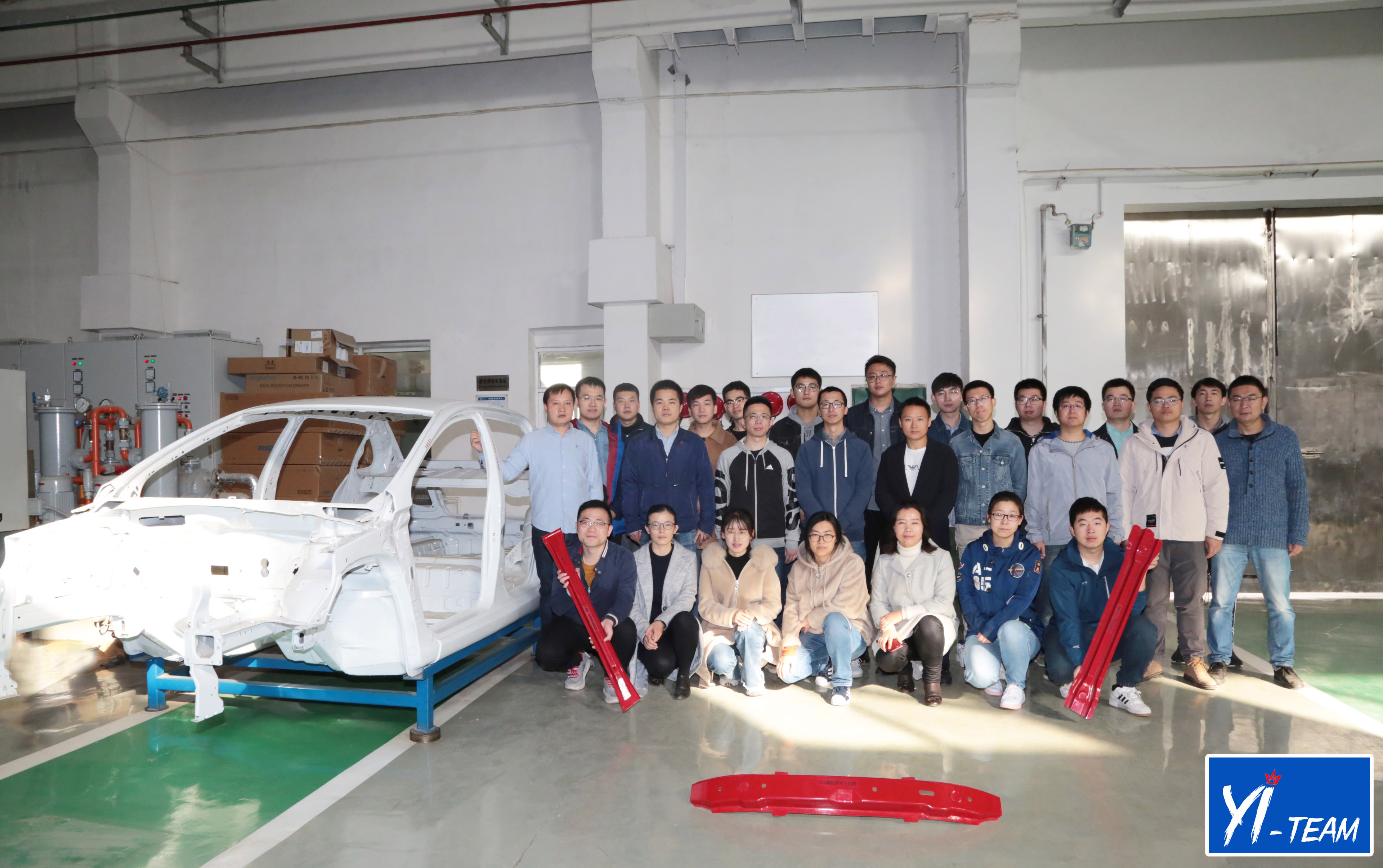
▲Members in Prof. Yi Hongliang’s research team