荷兰皇家科学院院士、代尔夫特理工大学杰出教授Sybrand van der Zwaag到轧制技术及连轧自动化国家重点实验室访问讲学
发布人: 发布时间:2024-04-26 浏览次数:10大中小
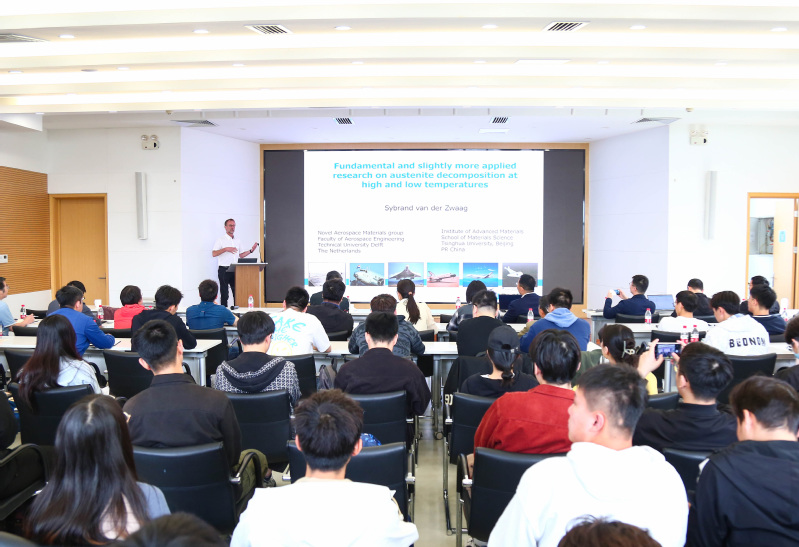
4月26日,应轧制技术及连轧自动化国家重点实验室(RAL)徐伟教授的邀请,荷兰皇家科学院院士、代尔夫特理工大学杰出教授Sybrand van der Zwaag到RAL访问讲学。Sybrand在411学术报告厅为师生作了题为《Fundamental and slightly more applied research on austenite decomposition at high and low temperatures》的学术报告,报告会由RAL实验室主任袁国教授主持。
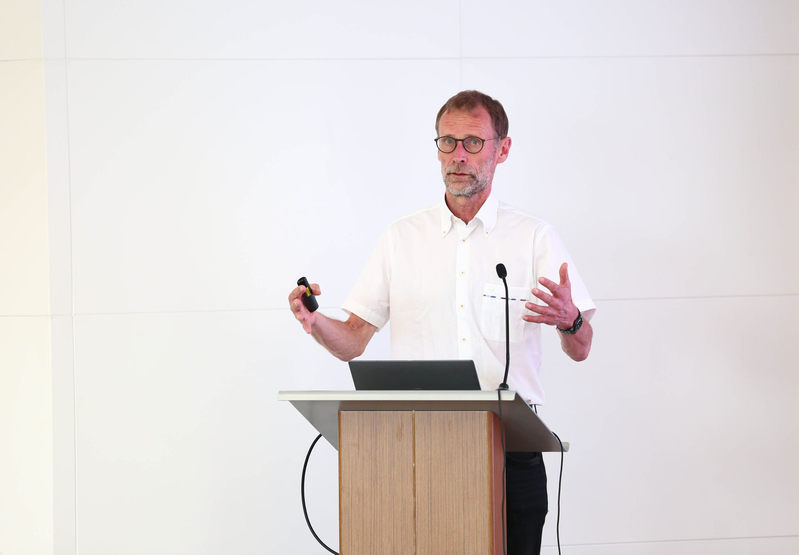
专家简介:
Sybrand van der Zwaag,荷兰皇家科学院院士、荷兰代尔夫特理工大学杰出教授、荷兰材料科学国家科学委员会(NWA)委员、荷兰代尔夫特理工大学Delft材料中心(DCMat)科学主任,是国际著名材料热动力学与相变专家。曾任荷兰国家自愈合材料研究计划首席科学家、伦敦帝国理工学院材料科学系国际咨询委员会委员、德国DFG项目自愈合材料联合主席、德国DFG项目自愈合材料联合主席和荷兰阿纳姆阿克苏(企业)研究实验室科学家。Sybrand van der Zwaag教授领导了代尔夫特理工大学飞机和航天器新材料研究,专注于黑色金属和有色金属的物理冶金、自愈合材料、高性能聚合物、功能性电陶瓷/聚合物复合材料、设计材料和传感材料的研究。至今为止获得多项荣誉及奖项,包括2018年法国材料学会Grande Medaille金质奖章、2018年美国TMS Champion H. Mathewson奖、2018年荷兰代尔夫特理工大学杰出科学和教育贡献银奖、2017年获得比利时蒙斯大学荣誉博士学位、2012年获得荷兰代尔夫特理工大学荣誉杰出教授称号、2009年获得中国中科院金属所李熏奖、2009年成为荷兰皇家科学院院士、2007年获得荷兰代尔夫特理工大学科学成就铜奖。Sybrand van der Zwaag教授在Science、Acta Materialia、Advanced Materials、Scripta Materialia、Advanced Functional Materials、Metallurgical and Materials Transactions A和Materials Science and Engineering A等期刊上发表了630余篇论文,引用次数> 21000,H因子为72。Sybrand van der Zwaag教授多年来一直与RAL实验室保持紧密的科研合作关系。多次应邀与东北大学RAL实验室,分别就自愈合金属材料、相变热动力学等方面进行学术交流与合作。依托国家留学基金委项目,多次接收实验室访问学者进行合作研究。
报告摘要:
This presentation will focus on the mechanisms of austenite decomposition at higher temperatures such as in a steel plant and on the decomposition of retained austenite in automotive steels at room temperature.
For the high temperature decomposition part I will focus on ferrite nucleation and the chemical drag on moving austenite-ferrite interfaces. Special attention will be devoted to the reversibility of the interface during thermal cycling and the insights gained by partial-cyclic transformation studies. Examples of how transformation induced chemical patterning can lead to new steel qualities will be presented.
For the low temperature decomposition part I will focus on the results of our studies using nano-beam X-ray diffraction to monitor the stability of individual retained austenite grains as a function of their own characteristics (grain size and carbon concentration and orientation), temperature and loading conditions (tension or shear).